

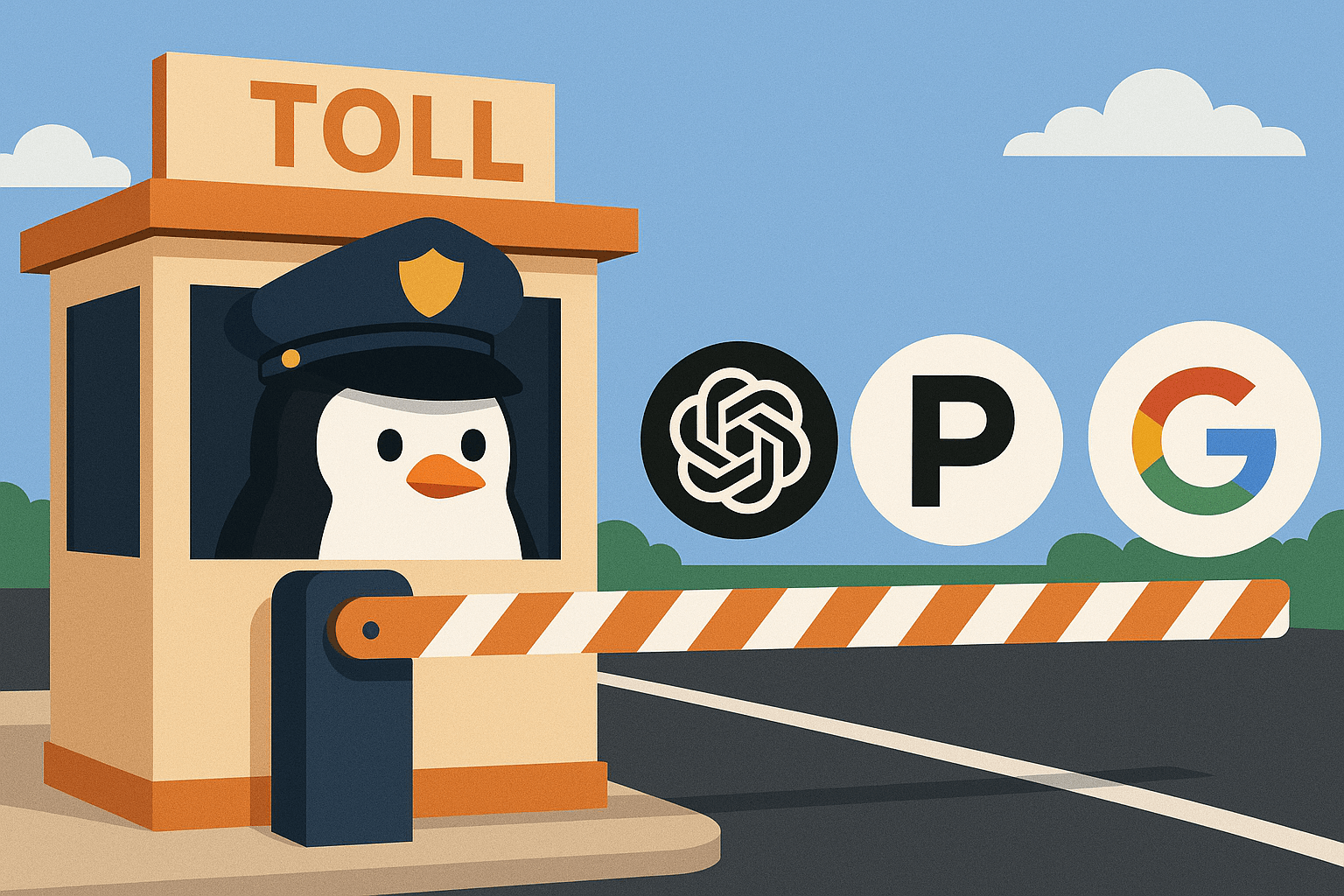
The uneasy relationship between artificial intelligence companies and online publishers is fast becoming a fight over money and control. AI firms are feeding their models with vast amounts of digital content, while the websites that produce it are left with shrinking traffic and declining ad revenue.
A study by cybersecurity firm HUMAN showed that some websites are now seeing up to 95 percent of their visits come from automated scraping bots. One ecommerce company reported more than 700 million scraping attempts in a single month. For publishers who depend on visitors and advertisers, this scale of extraction is not sustainable.
Cloudflare has stepped in with a tool called Pay Per Crawl. Since July, AI bots are blocked by default unless a site owner explicitly permits them. Publishers can now decide whether to give open access, reject crawlers altogether, or charge a fee each time their content is scraped. Cloudflare handles the billing, making it easier for smaller websites to enforce these choices.
Cloudflare’s chief executive Matthew Prince framed it as a matter of survival. “Original content is what makes the internet one of the greatest inventions of the last century. We need to give publishers control,” he said.
Several major players including The Associated Press, The Atlantic, Reddit and Stack Overflow have already signed on. Their participation signals how urgently creators want to take back control of their work.
Other solutions are emerging too. Amazon has introduced a service that helps publishers decide how their data is shared with AI developers through its Bedrock platform, offering licensing and usage management. Meanwhile, a startup called TollBit has positioned itself as a marketplace where AI companies can buy licensed access to data directly from websites. Both approaches point toward an ecosystem where content is no longer free for the taking but comes with clear rules and price tags.
Still, doubts remain. Critics warn that not all AI firms will play by the rules. Some can mask their identity or rotate IP addresses to sneak around restrictions. Others argue that flat rate pricing does not distinguish between in-depth journalism and basic informational content.
At the same time, the legal fight is heating up. The New York Times, Reddit and Dow Jones have already sued AI developers such as OpenAI and Anthropic, arguing that scraping and training on their work is not fair use.
Crux: Charging AI crawlers is no longer a thought experiment. Between Cloudflare’s model, Amazon’s licensing tools and TollBit’s marketplace, the internet is edging toward a world where content creators finally put a price on their words.