
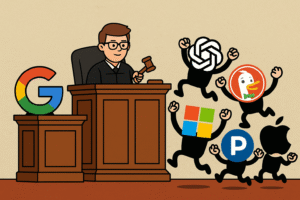


The buzz around ChatGPT’s new Atlas browser and its cousin Comet has reignited debate over the future of web browsing. Both products represent a new kind of “AI-native browser” where search, summarization, and automation blend seamlessly into the browsing experience. Yet the real story is not whether they can dethrone Google Chrome. It is how they pose a much greater risk to Microsoft Edge, especially in a market like India where Chrome’s dominance borders on monopoly.
Chrome’s Stronghold in India
In India, Chrome’s market position is overwhelming. Data from Statcounter for September 2025 shows Chrome commanding more than 93 percent of the mobile browser market and over 90 percent on desktop. Across all devices, Chrome holds about 92.8 percent share. Edge in comparison sits below one percent overall and around four percent on desktop.
This dominance is not accidental. Chrome rides on Google’s Android operating system, which powers the majority of smartphones sold in India. The browser comes preinstalled and is deeply integrated with Google services such as Search, Drive, and Gmail. Most users rarely bother to change their default apps, particularly on budget phones where storage and performance considerations make switching inconvenient. This ecosystem control ensures that Chrome’s position remains almost unassailable.
Lessons From Regulation and Litigation
Google has already faced antitrust investigations and default-browser scrutiny in multiple markets. From Europe to the United States, it has been forced to unbundle search and browser settings and to provide users with “choice screens.” These experiences have made Google more adept at navigating compliance frameworks. In India too, the Competition Commission of India (CCI) has imposed conditions on preinstalled Google apps, but Chrome’s share has hardly budged. Google’s legal and operational muscle allows it to adapt quickly without losing its market advantage.
Why Edge Is More Vulnerable
Microsoft Edge stands in a very different position. Its success has been tied largely to Windows PCs and to the AI narrative surrounding Copilot. Edge integrates Copilot as its differentiator, letting users summarize documents, search across tabs, and get generative answers. However, this “AI browser” positioning is exactly where ChatGPT’s Atlas and Comet are aiming to excel. If these new entrants deliver smoother, faster, and more intuitive AI assistance, they undercut Edge’s only major selling point.
Unlike Chrome, Edge does not have a hardware or operating system moat in India. On mobile devices, it has virtually no presence. In a country where over 85 percent of internet access happens through smartphones, this is a serious handicap. Even on desktops, Indian users tend to prefer Chrome because it syncs effortlessly with their mobile browsers. For Edge, any slowdown in Copilot adoption or perception of being a “me-too” AI browser could mean stagnation or decline.
The Rise of AI-Centric Browsing
AI browsers like Atlas and Comet reimagine the act of browsing itself. Instead of opening tabs and typing queries, users can ask, “Find me the best flights under ₹10,000 next week” or “Summarize today’s top stories on AI regulation.” The browser executes these tasks using natural language and memory. For users in India’s rapidly expanding digital economy, where mobile productivity and vernacular search are growing fast, this could be appealing. But it will mainly chip away at the space that Edge has tried to claim of being an intelligent assistant browser, rather than Chrome’s default dominance.
The Outlook
For Google, the AI browser wave is an evolution to integrate, not an existential threat. With Gemini AI already built into its ecosystem, Chrome can gradually absorb AI features without losing users. For Microsoft, however, the arrival of Atlas and Comet means renewed competition in the very category it helped create.
In India, the battle is not about who will replace Chrome. It is about which challenger can build relevance in a market that is mobile-first, Android-dominated, and increasingly AI-curious. Edge stands to lose more in that race than Chrome does.